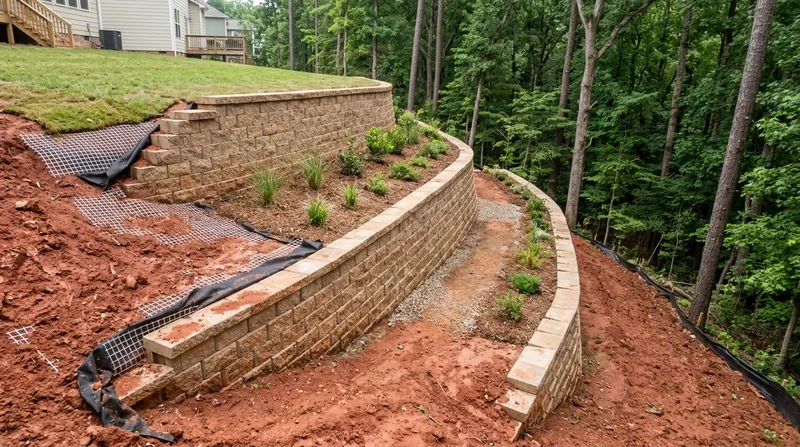




Slope Stabilization & Erosion Control in Durham: Built for Red Clay and Ravine Lots
When you need Slope Stabilization & Erosion Control in Durham, the ground under your house tells the story before you do. Durham sits in the rolling Piedmont of central North Carolina, where red clay hills fall away to the rocky Eno River and to New Hope Creek. South Durham and the Research Triangle Park sit on expansive Triassic Basin clays that swell and shrink with every wet and dry cycle, while Falls Lake and Jordan Lake press against the edges of the county. Housing runs from 1920s ravine lots in Forest Hills and Hope Valley to 1990s two-story homes in Woodcroft and Southpoint, and every one of those slopes moves differently.
We build and repair the terraced walls, geogrid reinforcement, and drainage that hold those slopes in place. If your yard is sliding toward a creek, your driveway cut is failing, or a wooded ravine is creeping toward the foundation, start with our retaining wall drainage service and we will tell you exactly what the hill is doing.
Why Durham Slopes Fail: Expansive Clay, Creek Banks, and Hurricane Remnants
Durham's failure mode is waterlogged red clay letting go after a downpour. The Triassic clays under south Durham swell when saturated and shrink when dry, so a slope that looks stable in August can slump after a February thaw or a hurricane remnant like Fran in 1996. Add subterranean termites working on old timber walls under tall loblolly pines, oaks, and tulip poplars, and you have a city where erosion control is not cosmetic.
- Ravine lots in Forest Hills and Hope Valley lose topsoil fast when stormwater sheets off a wooded slope.
- Creek-bank properties along Ellerbe and Third Fork creeks undercut their own footings during high water.
- Expansive Triassic clays in Woodcroft and RTP heave and crack poured concrete along steep driveway cuts.
- Old landscape timber and railroad tie walls from the 70s through the 90s rot and release the soil they were holding.
- Lakeside yards on Falls Lake and Jordan Lake erode at the shoreline every time the reservoir rises.
We read the slope, the soil, and the drainage path before we quote a single wall.
Key info: A Forest Hills ravine lot that loses a foot of topsoil a year is not a landscaping problem. It is a foundation problem waiting on the next hurricane remnant.
Durham County and City of Durham permitting rules apply to walls above roughly 4 feet from the footing or walls that support a driveway or structure, so verify thresholds with the local building department before you dig. You can check current requirements through the City of Durham website.
How We Stabilize a Durham Slope: Step by Step From the Footing Up
Every slope job starts with the water, not the wall. We walk the grade, find where stormwater enters and leaves the property, and check the soil profile before we set a stake. On a wooded ravine lot off Hope Valley Road, that often means catching a concentrated flow that has been dumping off a driveway for twenty years.
- We survey the slope, the soil, and the drainage path, and we identify the failure plane.
- We excavate to the footing and install a compacted gravel base that will not migrate in red clay.
- We place geogrid reinforcement in lifts behind the wall to tie the structure back into the hillside.
- We build the terrace or boulder toe with the right batter and set the drainage aggregate and outlet.
- We restore the surface with erosion control matting, seed, or stone so the slope stops shedding soil.
Each step is inspected before we backfill, because a slope stabilization job that skips the drainage step will fail within a season.
Key info: On a creek-bank lot near Third Fork Creek, we terraced the bank with segmental block and geogrid, then armored the toe with boulder. The house above stopped losing ground within one storm season.
If the slope is already moving under a failing wall, see our leaning and collapsed wall repair page before the hill takes the wall with it.
Slope Stabilization Approaches We Use on Durham Terrain
No single method fits every Durham slope. A lakeside bank on Jordan Lake and a driveway cut in Treyburn call for different tools, and we match the approach to the soil, the grade, and what sits above.
| Approach | Description | Best for |
|---|---|---|
| Terraced segmental block walls | Tiered block walls with geogrid tiebacks and drainage aggregate behind each lift. | Wooded ravine lots in Forest Hills and Hope Valley. |
| Boulder toe and rock armoring | Natural stone placed at the toe to absorb creek and wave energy. | Creek banks on the Eno and New Hope, and lake shorelines. |
| Geogrid reinforcement | Grid layers compacted into the fill to stabilize deep failure planes. | Tall or tiered walls above driveways and walk-out basements. |
| Surface erosion control | Matting, seed, and stone to stop topsoil loss on exposed red clay. | Steep yards in Parkwood and Northgate Park. |
| Poured concrete along steep cuts | Rigid walls set on a proper footing for tight driveway cuts. | Steep driveway cuts in Treyburn and Croasdaile. |
We choose the approach on site, because the soil and the water decide what will hold.
Slope Stabilization & Erosion Control Cost in Durham: What to Expect
Slope work is priced by the linear foot and by the cubic yard of soil moved, so a small bank repair and a full ravine terrace are different projects. We start every job with a free estimate, and we put the number in writing before any equipment rolls onto the property. The full pricing overview breaks down the ranges in detail.
Several factors move the price: how much soil is moving, how steep the grade is, how far the equipment has to travel, how close the work is to the house or driveway, and whether the slope needs geogrid, boulder armoring, or drainage correction. A tight ravine lot in Hope Valley costs more to work than an open yard in Bahama. Getting two or three estimates is smart, because a low bid that skips the drainage step will cost you again in a season.
Hiring a Retaining Wall Contractor Near Durham: What Homeowners Should Check
A slope stabilization job is only as good as the crew that builds it. Ask for proof of insurance, call references on wooded ravine work, and confirm the contractor understands Durham's permit thresholds for walls above roughly 4 feet from the footing. If your lot sits in a homeowners association in Woodcroft or Southpoint, check the architectural review rules before the first stake goes in.
Get the scope in writing, including drainage and erosion control, not just the wall. We are fully insured, and we hold NCMA Segmental Retaining Wall Installer Certification for the block and geogrid work. Start with a free estimate and we will walk the slope with you.
Slope Stabilization & Erosion Control in Durham: Pricing Guide
| Service | Price | Details |
|---|---|---|
| Slope inspection and written estimate | Free | On-site walk of the slope, soil and drainage review, written scope before any work begins |
| Small bank repair and erosion control | Starting at $1,800 | Surface matting, seed, stone toe and minor regrading on a short residential slope |
| Terraced segmental block wall with geogrid | Starting at $65 per sq ft of wall face | Excavation, gravel base, geogrid lifts, drainage aggregate and outlet included |
| Creek-bank or lakeside stabilization | On estimate | Boulder toe, bank regrading and erosion armoring sized to the water and grade |
| Travel | Included | In Durham and surrounding areas, no separate call-out or mileage fee |
| Estimate | Free | Response within 24h at (984) 538-7560, no obligation to book |
Indicative pricing, the exact cost depends on square footage, finish, and site access. Free personalized estimate within 24h at (984) 538-7560.


