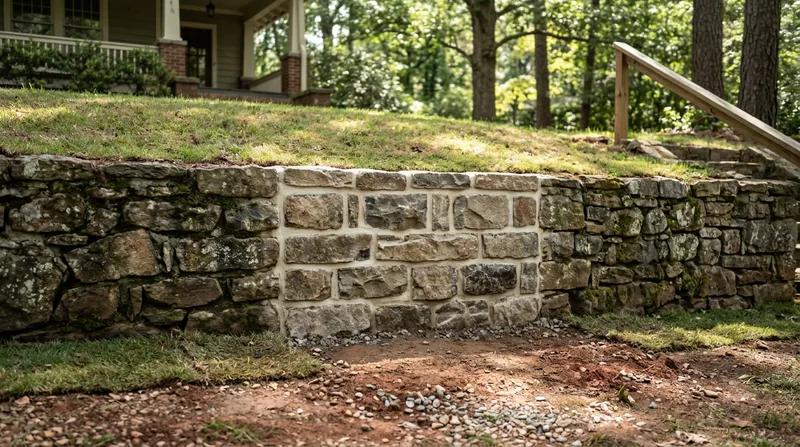




Retaining Wall Repair in Durham: Stop the Lean Before It Becomes a Collapse
Durham sits on a rolling Piedmont where red clay hills drop toward the Eno River and New Hope Creek, and that clay is the reason most walls here fail. The expansive Triassic clays under south Durham and Research Triangle Park swell after every summer downpour and shrink through winter freezes, pushing and pulling on walls that were never built to take the movement. Add the tall loblolly pines and oaks dropping roots and shade, and you get leaning, bowing, and cracked walls from Trinity Park to Woodcroft. Retaining Wall Repair in Durham means diagnosing the actual failure, water pressure or soil movement or a bad footing, and correcting it before the wall goes over. We handle leaning wall repair, drainage correction, tieback anchors, and partial rebuilds across Durham and the Triangle. If your wall is already down or past repair, our retaining wall replacement service takes over from there.
Why Retaining Walls Fail in Durham's Red Clay and Expansive Soil
Most wall failures we see in Durham are not the block's fault. They are a water problem. A wall backfilled with clay that holds water acts like a dam, and every heavy summer storm or hurricane remnant like Fran in 1996 loads that saturated soil against the face. The wall bows, the top courses tip out, and cracks open at the corners. Expansive clays make it worse by heaving the footing itself.
- Drainage that clogs or was never installed lets hydrostatic pressure build behind the wall.
- Expansive Triassic clay swells and shrinks, cracking mortar and shifting block courses.
- Timber and railroad tie walls from the 70s through the 90s rot and get hit by subterranean termites.
- Tree roots from oaks and tulip poplars pry at footings and lift wall sections.
- Footings set too shallow on a slope give way under freeze and thaw cycles.
Each of these failure modes calls for a different repair, which is why we diagnose before we quote. You can check the City of Durham's building permit guidance for wall thresholds, since many jurisdictions require a permit above roughly 4 feet from the footing.
Key info: In Forest Hills and Hope Valley, 1920s to 1950s homes sit on wooded ravine lots where fieldstone and granite garden walls routinely fail after decades of clay pressure. A wall that looks fine in April can be leaning by August after two heavy storms.
How We Diagnose and Repair a Failing Wall in Durham
We start by finding out why the wall moved. That means digging a test pit behind the face, checking the footing depth, reading the soil, and looking at where water actually goes during a storm. A wall that only needs drainage correction is a very different job from one that needs tieback anchors or a partial rebuild, and we tell you which one you have.
- We inspect the wall face, footing, and drainage, and we photograph the failure pattern.
- We dig a test pit to confirm soil type and backfill condition behind the wall.
- We correct drainage first, adding perforated pipe, gravel, and filter fabric where it is missing or clogged.
- We install tieback anchors or helical anchors to pull a leaning wall back to plumb when the structure is sound.
- We rebuild failed sections, resetting block or stone on a proper compacted base.
- We restore the surface, backfill with free-draining material, and walk the wall with you at the end.
For walls that need water redirected away from the face, we coordinate with our retaining wall drainage work so the fix holds. If the wall has already gone over, see our leaning and collapsed wall repair page.
Key info: A segmental block terrace holding a walk-out basement in Woodcroft came in leaning about 3 inches at the top after years of clogged drain rock. We reset the top four courses, replaced the drainage behind the face, and tied the wall back with anchors. No full rebuild was needed.
Repair Methods We Use on Durham Retaining Walls
The right method depends on how the wall is built and how it failed. A poured concrete wall along a steep driveway cut in Northgate Park takes a different repair than a fieldstone garden wall in Duke Park or a boulder wall on a creek-side ravine. We match the method to the structure and the soil.
| Approach | Description | Best for |
|---|---|---|
| Drainage correction | Clear clogged drains, add perforated pipe, gravel, and filter fabric behind the face. | Walls bowing from water pressure with sound block or concrete. |
| Tieback and helical anchors | Anchor the wall back into stable soil to pull a leaning face to plumb. | Leaning walls where the block or concrete is still intact. |
| Partial rebuild | Remove and reset failed courses on a compacted, properly drained base. | Cracked or bulging sections of segmental block and stone walls. |
| Timber and tie wall repair or replacement | Replace rotted wood with block or stone, or rebuild with treated timber. | 70s to 90s timber walls with rot and termite damage. |
| Footing and base repair | Underpin or replace a shallow footing on expansive clay slopes. | Walls settling or heaving where the base has failed. |
We choose the least invasive method that will actually hold, and we tell you honestly when a repair will not last. Our team holds NCMA Segmental Retaining Wall Installer Certification and is fully insured.
Retaining Wall Repair Cost in Durham: What to Expect
Most retaining wall repairs in Durham start from $1,500 and go up from there. A drainage correction on a short wall is on the low end, while tieback anchors, partial rebuilds, and footing work push the number higher. The biggest cost drivers are wall height, access to the back of the wall, how much soil has to be moved, and whether the footing is sound. A wall on a tight ravine lot in Forest Hills costs more to work on than one with a clear driveway approach.
We quote after a site visit, not over the phone, because the failure mode changes the scope. Getting two or three estimates is smart on any repair over a couple thousand dollars, and it protects you from a contractor who quotes a full rebuild when drainage correction would do. Our pricing overview lays out the ranges in more detail.
Key info: A leaning block wall in Parkwood that needs anchors and drainage often lands between $3,000 and $6,000. The same wall left alone through another hurricane season can turn into a $15,000 rebuild. Repair early is the cheaper path.
Retaining Wall Repair Near Me: How to Vet a Contractor Near Durham
When you search for retaining wall repair near me in Durham, you get a long list and not much to separate them. Here is what actually matters. Ask for proof of insurance, ask for references on repair work (not just new builds), and ask how they diagnose the failure. A contractor who quotes a number without looking behind the wall is guessing.
- Confirm the company carries insurance and can produce a certificate before work starts.
- Get two or three written estimates that describe the repair method, not just a price.
- Ask for references from Durham repair jobs and call them.
- Ask who pulls the permit if your wall is above the local height threshold.
- Check HOA rules in neighborhoods like Treyburn or Croasdaile before changing wall materials.
Ready to get a real diagnosis? Reach out through our contact page or call (984) 538-7560. We serve Durham and the surrounding Triangle, and we tell you straight whether your wall needs a repair or a replacement.
Retaining Wall Repair in Durham: Pricing Guide
| Service | Price | Details |
|---|---|---|
| Drainage correction and minor wall repair | Starting at $1,500 | Clears clogged drains, adds gravel and pipe, and resets minor movement on short walls. |
| Leaning wall tieback anchor repair | Starting at $3,000 | Anchors a leaning face back to stable soil, priced by wall height and anchor count. |
| Partial block or stone rebuild | Starting at $4,500 | Removes and resets failed courses on a new compacted base, with drainage restored. |
| Timber or railroad tie wall repair | Starting at $2,500 | Replaces rotted sections or converts failing timber to block, priced by linear footage. |
| Complex or large-scale job | On estimate | Tall tiered walls, footing repair, or tight ravine access need an on-site look first. |
| Estimate | Free | Response within 24 hours at (984) 538-7560, no obligation to book. |
Indicative pricing, the exact cost depends on square footage, finish, and site access. Free personalized estimate within 24h at (984) 538-7560.


