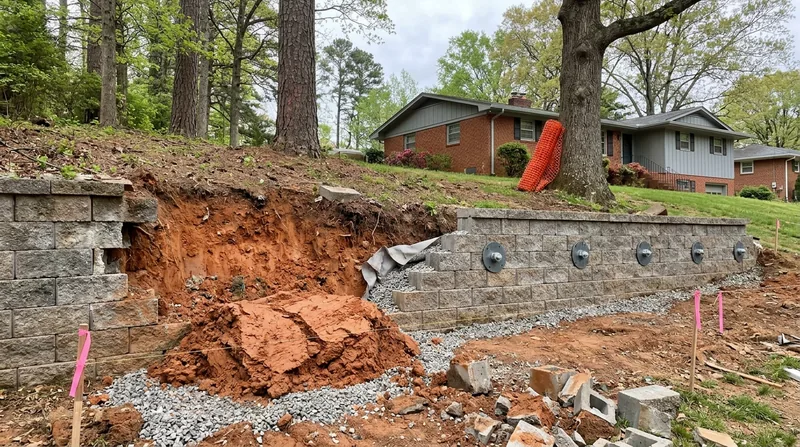




Leaning and Collapsed Wall Repair in Durham: When the Ground Moves
Durham sits in the rolling Piedmont where red clay hills drop toward the Eno River and New Hope Creek, and that ground moves. We provide Leaning & Collapsed Wall Repair in Durham for homeowners whose segmental block, timber, or fieldstone walls have started to bulge, tilt, or let go after a heavy summer storm. The expansive Triassic clays under south Durham and Research Triangle Park swell with every wet season and shrink in the dry months, pushing walls out of plumb year after year. Add hurricane remnants like Fran and the downpours that hit the Eno and Third Fork creek corridors, and even a well-built wall can fail. If your wall is already leaning or has collapsed, we respond fast, stabilize the slope, and rebuild it right. For routine fixes that have not reached the collapse stage, see our retaining wall repair service.
Why Leaning and Collapsed Walls Are So Common in Durham's Clay Hills
Durham's building stock spans a century of wall construction, and each era fails in its own way. The 1900s to 1930s Queen Anne and Craftsman homes in Trinity Park, Watts-Hillandale, and Morehead Hill often have fieldstone or granite garden walls built without modern drainage. The 1960s to 1980s ranches in Parkwood and Northgate Park were commonly terraced with landscape timber and railroad ties that are now rotting from the inside. And the 1990s to 2020s two-story homes in Woodcroft, Southpoint, and Treyburn sit behind segmental block walls that can bulge when the clay behind them stays saturated. Three local forces drive most failures:
- Expansive Triassic clay swells against the back of the wall and pushes it forward, especially on south Durham and RTP lots.
- Blocked or missing drainage lets hydrostatic pressure build until the wall face bows outward or a section drops.
- Rotting timber and railroad ties lose structural strength after decades under loblolly pines and oaks.
- Tree roots and storm runoff from the wooded ravine lots in Forest Hills and Hope Valley undercut footings.
Any one of these can turn a small lean into a full collapse after a single heavy rain, so it pays to act while the wall is still standing.
Key info: A segmental block wall on a Woodcroft slope that leans more than 2 inches out of plumb over 4 feet of height is usually showing drainage failure, not just age. We see this most after July and August downpours when the clay behind the wall is fully saturated.
For the official rules on walls that support a driveway or structure, check the City of Durham building department before you rebuild, since thresholds vary and taller or tiered walls may need engineered drawings.
How We Repair a Leaning or Collapsed Wall in Durham
We start by finding out why the wall moved, because rebuilding the face without fixing the cause just buys you another failure. On a recent job off Hope Valley Road, a 1970s railroad tie wall had rotted through and pushed a section of the slope into the backyard after a storm. We removed the failed ties, corrected the drainage behind the wall, and rebuilt the section with segmental block. Every repair follows the same field sequence:
- We inspect and probe the wall face, footing, and soil behind it to find the failure mode.
- We stabilize the slope with temporary shoring or tieback anchors so nothing else moves during the work.
- We correct the drainage by clearing or installing perforated pipe, gravel, and filter fabric behind the wall.
- We rebuild or reset the failed section, matching block, stone, or timber to the existing wall where possible.
- We compact and backfill in lifts so the repaired wall carries the load the way it was designed to.
If the wall is past saving, we walk you through a full rebuild rather than patching a structure that will fail again next season.
Key info: After Hurricane Fran in 1996, dozens of boulder and timber walls along the New Hope Creek ravine lots in Chapel Hill and south Durham failed in a single week. We keep tieback anchor stock on hand for exactly that kind of emergency response.
If your wall has already dropped a section, our team can also handle a full retaining wall replacement when repair no longer makes sense.
Repair Approaches We Use for Leaning and Collapsed Walls
The right approach depends on how far the wall has moved, what it is made of, and what is sitting above it. We choose the least invasive method that will actually hold, and we tell you plainly when a repair will not last.
| Approach | Description | Best for |
|---|---|---|
| Tieback anchors | We drive anchors into stable soil behind the wall and connect them to the wall face to pull it back toward plumb. | Leaning block or concrete walls with an intact face and sound footing. |
| Drainage correction | We clear or replace the drain pipe, gravel, and filter fabric behind the wall to relieve hydrostatic pressure. | Bulging walls where water, not soil, is the main driver. |
| Partial rebuild | We remove and reset the failed section, then recompact the backfill in lifts to match the rest of the wall. | Localized collapse or a dropped section of block, stone, or timber. |
| Full rebuild | We tear out the failed wall and rebuild with new block or stone, proper drainage, and compacted backfill. | Walls that are out of plumb throughout or made of rotted timber. |
| Slope stabilization | We regrade, add erosion control, and reinforce the slope above the wall so it stops pushing downward. | Ravine lots and steep cuts where the hillside itself is moving. |
We match the method to the wall, not the other way around, so you pay for the repair your wall actually needs.
Leaning and Collapsed Wall Repair Cost in Durham: What to Expect
Most leaning and collapsed wall repairs in Durham start around $2,500, and that figure covers a localized repair with drainage correction on a typical residential wall. The final price depends on how much of the wall has moved, how hard it is to reach, and whether the footing is still sound. A short bulging section on a Woodcroft block wall is a very different job from a fully collapsed timber wall on a Forest Hills ravine lot. Expect the number to climb when the wall supports a driveway, a walk-out basement, or a structure above it. Getting two or three written estimates is smart, because a contractor who quotes without probing the soil behind the wall is guessing. Our full pricing overview breaks down the ranges in more detail.
What to Look for When Hiring a Retaining Wall Contractor Near Me in Durham
Retaining wall repair is not a job for a general handyman, because a bad repair can fail again within a season and take the slope with it. Ask any contractor near Durham three things before you sign: whether they carry liability and workers' comp coverage, whether they will put the repair method and drainage plan in writing, and whether they can show you recent walls they built in similar clay. Call the references, and look at walls that have been through at least one full wet season. Confirm who pulls the permit if your wall is above the local height threshold or supports a surcharge, and check any HOA rules before work starts. We are fully insured and carry NCMA Segmental Retaining Wall Installer Certification, and we will provide a certificate of insurance on request. Reach out through our contact page to schedule a free estimate.
Leaning & Collapsed Wall Repair in Durham: Pricing Guide
| Service | Price | Details |
|---|---|---|
| Localized wall repair | Starting at $2,500 | Covers a small leaning or bulging section with drainage correction and recompacted backfill. |
| Partial rebuild with tieback anchors | Starting at $4,800 | Resets a failed section and anchors it into stable soil behind the wall. |
| Full wall rebuild | Starting at $8,500 | Removes and replaces a wall that is out of plumb throughout or built of rotted timber. |
| Emergency stabilization | On estimate | Collapsed walls near a structure or driveway need an on-site look before a number is given. |
| Travel | Included | In Durham and surrounding areas, no separate call-out or mileage fee. |
| Estimate | Free | Response within 24h at (984) 538-7560, no obligation to book. |
Indicative pricing, the exact cost depends on square footage, finish, and site access. Free personalized estimate within 24h at (984) 538-7560.


