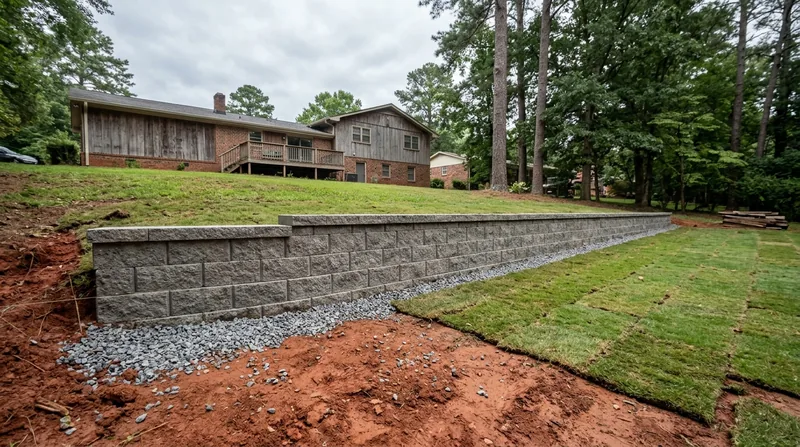




Retaining Wall Replacement in Durham: Tearing Out the Old Wall and Building It Right
Durham sits on rolling Piedmont ground where red clay hills drop toward the Eno River and the rocky ravines above New Hope Creek. The expansive Triassic clays under south Durham and Research Triangle Park swell after every summer downpour, then shrink through winter freezes, and that cycle punishes every wall in the county. If you need Retaining Wall Replacement in Durham, you are usually looking at a timber or railroad tie wall from the 70s or 90s that has rotted through, or a block wall that has finally given up its batter. We tear the old structure out, haul it away, and rebuild with drainage and materials that suit Piedmont clay. Call our team for a free estimate at (984) 538-7560 and we will tell you straight whether the wall can be saved or has to come out.
The failure mode that dominates here is not frost heave and it is not marine moisture. It is timber rot and clay water pressure. A landscape timber wall on a slope above Ellerbe Creek can look fine in April and be hollowed by subterranean termites and fungal decay by the next fall. Segmental block walls in Forest Hills and Hope Valley often fail because the original builder skipped the gravel drainage chimney, so hydrostatic pressure from saturated clay pushes the base course forward. Replacement is a drainage problem first and a block problem second.
Why Failed Walls Are So Common on Durham's Clay Slopes
The housing stock here tells the story. Old West Durham and Walltown still have mill-village lots with timber walls holding small terraces. Trinity Park and Watts-Hillandale have fieldstone and granite garden walls from the 1920s that have shifted for decades. Parkwood and Northgate Park ranches sit behind railroad tie walls built in the 70s and 80s that are now at end of life. Woodcroft, Southpoint and Treyburn have segmental block terraces from the 90s and 2000s that are leaning because the drainage was undersized from day one.
- We remove termite-eaten railroad ties and landscape timbers that no longer hold soil.
- We tear out block walls whose base course has kicked forward under clay pressure.
- We replace failed drainage behind walls that were built without a gravel chimney or perforated pipe.
- We haul away old concrete, timber and stone so the site is clean before the new build starts.
- We rebuild with segmental block, poured concrete, boulder or natural stone suited to the slope.
Most of the walls we replace in Durham were never engineered for the water load that Triassic clay delivers, and that is exactly what we correct on the rebuild.
Key info: In Hope Valley and Forest Hills, we routinely find 1950s poured concrete walls with no weep holes at all. Water builds behind them for years, then a single hurricane remnant like Fran in 1996 or a heavy July downpour pushes the wall out. The replacement always includes a drainage chimney and outlet, because the old wall never had one.
Durham County publishes its own permitting guidance through the City of Durham and Durham County building departments, and it is worth a call before any tall wall project moves forward.
How We Replace a Retaining Wall in Durham, Step by Step
We do not patch a failed wall and call it replacement. The old structure comes out completely, the soil behind it gets examined, and the new wall gets designed for the actual water load. That means the drainage goes in before the first block is set, not after. On a typical Durham job we work in this order.
- We walk the site and measure the wall height, the slope above it and the surcharge it carries (driveway, patio or structure).
- We check permit thresholds with the City of Durham or Durham County building department, since walls above roughly 4 feet from the footing or walls carrying a surcharge usually need a permit.
- We demo the old wall, cut out roots where needed, and haul away every load of timber, block, concrete or stone.
- We excavate to the footing depth and build a compacted gravel base that will not move in expansive clay.
- We install the drainage chimney, filter fabric and perforated pipe, then daylight the outlet to a safe discharge point.
- We set the new wall with the correct batter, backfill in lifts and compact each lift as we go.
- We cap the wall, clean the site and walk the finished job with you.
If the slope above the wall is unstable, we bring in slope stabilization and erosion control so the new wall is not fighting a moving hillside from day one.
Key info: A 2019 job off Hope Valley Road had a 60-foot timber wall rotting into a ravine. We tore it out, found the original builder had buried construction debris behind it, hauled 14 tons of rubble and rotten timber off site, and rebuilt in segmental block with a full drainage chimney. The homeowner had been told for years the wall was fine.
Replacement Methods We Use on Durham Walls
Not every failed wall should be replaced with the same material. A creek-side ravine wall in Forest Hills and a driveway cut in Treyburn carry different loads and different water. We match the method to the site, the slope and the budget, and we are certified through the NCMA Segmental Retaining Wall Installer program for block work.
| Approach | Description | Best for |
|---|---|---|
| Segmental block replacement | Tear out the old wall and rebuild with engineered SRW block, gravel base and a full drainage chimney. | Terraced yards in Woodcroft and Southpoint, walls up to 6 feet. |
| Poured concrete replacement | Remove the failed wall and pour a reinforced concrete wall with weep holes and a footing keyed into clay. | Steep driveway cuts and walls carrying a surcharge. |
| Boulder and natural stone replacement | Haul out the old timber or block and rebuild with native boulder or fieldstone set into a gravel base. | Creek-side ravines and wooded lots in Forest Hills and Hope Valley. |
| Railroad tie and timber tear-out | Full removal of termite-eaten ties and timbers, then replacement in block, concrete or stone. | 1970s and 1980s walls in Parkwood and Northgate Park. |
| Tiered wall rebuild | Replace multi-level terraces with engineered tiers, proper setbacks and drainage between each level. | Sloped backyards in Trinity Park and Watts-Hillandale. |
Every method above includes haul-away of the old wall and a drainage system sized for the clay behind it.
Retaining Wall Replacement Cost in Durham: What to Expect
Replacement pricing starts at From $35/sq ft for a standard segmental block wall with drainage, and it climbs from there based on height, access and what we find behind the old wall. A 3-foot garden wall in Duke Park is a very different job from a 7-foot wall holding a driveway cut in Treyburn. The figure covers demolition, haul-away, new base, drainage and the new wall face.
What moves the number: wall height and total square footage, the material you choose, how tight the access is for a machine or a wheelbarrow, whether the old wall hides debris or roots, and whether the wall carries a surcharge like a driveway or structure. Expansive Triassic clay in south Durham can also require deeper footings and more gravel, which adds cost but prevents a second failure.
Get two or three written estimates and compare scope line by line, not just the bottom number. A cheap quote that skips the drainage chimney is not a cheaper wall, it is a wall that fails again in five years. Our full pricing overview breaks down what each tier includes.
Hiring a Retaining Wall Contractor Near Me in Durham: What to Check
Replacement work is only as good as the crew doing it, and Durham has plenty of outfits that will set block without a drainage plan. Ask direct questions before you sign anything. A contractor who cannot explain how the water gets out of the wall is not the right contractor.
- Confirm the company carries general liability and workers compensation coverage, and ask for a certificate before work starts.
- Get at least two or three written estimates that list demolition, drainage and materials separately.
- Ask for references from jobs in Durham and go look at walls that are three or more years old.
- Ask who pulls the permit if the wall is above the local threshold or carries a surcharge, and verify the answer with the City of Durham or Durham County building department.
- Check HOA rules before demolition, since some Durham neighborhoods restrict wall height, material or color.
- Confirm the quote includes haul-away, because old timber and broken block do not disappear on their own.
When you are ready to talk through your wall, contact us for a free estimate and we will give you a straight answer on replacement versus repair.
Retaining Wall Replacement in Durham: Pricing Guide
| Service | Price | Details |
|---|---|---|
| Segmental block wall replacement | Starting at $35/sq ft | Includes demolition, haul-away, gravel base, drainage chimney and new SRW block face. |
| Railroad tie and timber wall tear-out | Starting at $40/sq ft | Covers full removal of rotted ties and timbers plus replacement in block or stone. |
| Poured concrete wall replacement | Starting at $55/sq ft | Reinforced concrete with weep holes and footing keyed into Piedmont clay. |
| Boulder and natural stone rebuild | Starting at $65/sq ft | Native stone set into gravel base, priced by stone size and haul distance. |
| Tiered or engineered wall rebuild | On estimate | Multi-level or surcharge walls need an on-site look and possibly engineered drawings. |
| Travel | Included | In Durham and surrounding areas, no separate call-out or mileage fee. |
| Estimate | Free | Response within 24h at (984) 538-7560, no obligation to book. |
Indicative pricing, the exact cost depends on square footage, finish, and site access. Free personalized estimate within 24h at (984) 538-7560.


