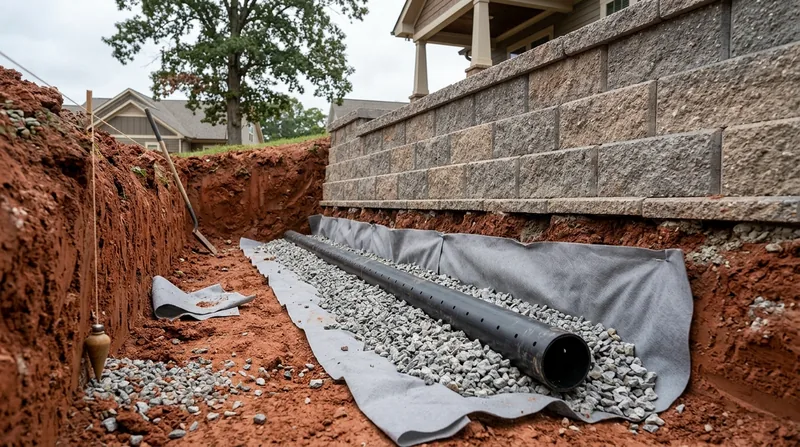




Retaining Wall Drainage in Durham: Why Water Decides Whether Your Wall Stands
If you own a retaining wall in Durham, the real enemy is not the weight of the soil behind it. It is the water trapped inside that soil. Durham sits on rolling Piedmont ground where heavy red clay holds moisture for days after a storm, and the expansive Triassic clays under south Durham and Research Triangle Park swell when wet and shrink when dry. That cycle pushes and pulls on every wall in Trinity Park, Watts-Hillandale, Forest Hills and Hope Valley. Proper Retaining Wall Drainage in Durham relieves that pressure before it cracks a block face, bows a timber wall, or sends a hillside sliding toward your foundation. We design and install French drains, weep holes, gravel backfill and filter fabric built for this exact soil. If your wall is already showing movement, start with our leaning and collapsed wall repair page before the damage gets worse.
Why Drainage Matters More in Durham's Red Clay Than Anywhere Else in the Piedmont
Hydrostatic pressure is the leading cause of retaining wall failure across the Piedmont, and Durham's soil profile makes it worse. Red clay drains slowly, so water stacks up behind a wall instead of percolating away. Add our humid summers, hurricane remnants like Fran in 1996, and ice storms that freeze saturated backfill, and you get a wall working against forces it was never built to handle. Timber and railroad tie walls from the 70s and 90s rot fastest because they sit wet year round.
- Saturated backfill adds hundreds of pounds of lateral load per linear foot, which pushes walls out of plumb.
- Expansive Triassic clays in south Durham swell against wall faces and open cracks in block and concrete.
- Water seeping through failed joints washes out fines and creates voids under footings.
- Timber and railroad tie walls absorb moisture and invite subterranean termites under tall loblolly pines.
- Downspouts and driveway runoff dumped behind a wall overload a system that was never sized for it.
Every one of these failure modes starts with water that had nowhere to go, and every one of them is cheaper to prevent than to rebuild.
Key info: A segmental block terrace holding a walk-out basement in Woodcroft can look perfectly fine on the surface while the gravel core behind it is clogged with clay silt. We have opened walls like that in south Durham and found standing water six inches deep behind the face.
Durham County and City of Durham permitting rules apply to walls above roughly four feet and to any wall carrying a surcharge like a driveway. You can verify current thresholds with the City of Durham before you schedule work.
How We Build Drainage That Actually Works in Durham Soil
We do not guess at drainage. We read the slope, the soil and the water source first, then build a system sized for the wall and the runoff it actually sees. Our crews hold NCMA Segmental Retaining Wall Installer Certification and are fully insured. Here is the sequence we follow on a typical Durham job.
- We walk the wall and the uphill grade to find where water enters, whether from a roof, a driveway cut or a spring in the clay.
- We excavate behind the wall face and remove saturated, clay-heavy backfill down to the footing.
- We line the trench with filter fabric so clay fines cannot migrate into the drain and clog it.
- We set a perforated French drain pipe at the low point, wrapped in washed gravel, with a positive fall to daylight or a dry well.
- We backfill with clean, free-draining gravel instead of the native red clay.
- We core weep holes through concrete and block faces at the footing and at intervals up the wall.
- We test the system with a hose before we close the trench and restore the grade.
That sequence is the difference between a wall that sheds water and one that stores it.
Key info: On a ravine lot in Forest Hills, we found a 1970s timber wall with no drain at all and a downspout discharging directly behind it. We replaced the wall's drainage with fabric, gravel and a French drain tied to a daylight outlet, and the wall has stayed plumb through three hurricane seasons. If your wall sits on a slope like that, our slope stabilization and erosion control work pairs directly with drainage.
Drainage Approaches We Use on Durham Walls
No single method fits every wall. The right approach depends on wall height, material, the slope above it and how much water the site collects. Here is how we match the method to the job.
| Approach | Description | Best for |
|---|---|---|
| French drain behind the wall | Perforated pipe in washed gravel, wrapped in filter fabric, falling to daylight. | Long walls and hillside lots in Forest Hills and Hope Valley |
| Weep holes and face drainage | Cored outlets through concrete and block that let water escape the wall face. | Poured concrete driveway cuts and older block walls |
| Gravel backfill and filter fabric | Clean stone replaces clay backfill, with fabric keeping fines out of the drain. | Every new wall and most repairs in Durham red clay |
| Surface and downspout control | Regrading, swales and downspout extensions that move roof water away from the wall. | Walls below rooflines in Trinity Park and Duke Park |
| Chimney and toe drains | Vertical gravel columns and footing drains that catch water at the base. | Tall tiered walls and boulder walls on creek-side ravines |
We size each of these to the wall in front of us, not to a generic formula, because a wall in Rougemont on a wooded slope sees different water than a terrace in Southpoint.
Retaining Wall Drainage Cost in Durham: What to Expect
Drainage work starts from $2,500 for a straightforward French drain and gravel backfill behind an existing wall. That figure covers excavation, fabric, pipe, washed gravel and restoration on a typical residential wall. Cost climbs with wall length and height, how much saturated clay has to come out, whether the outlet has to run a long distance to daylight, and whether the wall needs partial rebuilding before drainage can go in. Access matters too: a tight lot in Morehead Hill costs more to work than an open backyard in Treyburn.
Getting two or three written estimates is smart money. Ask each contractor what drain pipe size they will use, where the water will discharge, and whether the price includes restoring the grade. A cheap quote that skips the filter fabric will clog within a few seasons in Durham clay. Our full pricing overview breaks down how we scope these jobs.
What to Look For When Hiring a Retaining Wall Drainage Contractor Near Me in Durham
Drainage is invisible once the trench is closed, so hire on process, not promises. Ask for proof of insurance, check references on jobs at least two years old, and confirm the contractor understands how permits apply to walls over four feet or walls carrying a driveway. If your property sits in an HOA or a historic district, confirm the rules before work starts. We are fully insured and will provide a certificate on request.
A good contractor will explain where the water goes before quoting a number. If nobody asks about your downspouts or the slope above the wall, keep calling. Reach us through our contact page to schedule a free, no-obligation look at your wall. If you are in the 27701 area, our Durham 27701 drainage page covers the older in-town lots in more detail.
Retaining Wall Drainage in Durham: Pricing Guide
| Service | Price | Details |
|---|---|---|
| French drain and gravel backfill | Starting at $2,500 | Includes excavation, filter fabric, perforated pipe, washed gravel and grade restoration on a typical residential wall. |
| Weep holes and face drainage | Starting at $850 | Coring and sleeving outlets through concrete or block, priced by wall length and number of outlets. |
| Full drainage rebuild with wall repair | On estimate | Needed when saturated backfill has already bowed or cracked the wall and partial rebuilding is required. |
| Travel | Included | in Durham and surrounding areas, no separate call-out or mileage fee |
| Estimate | Free | Response within 24h at (984) 538-7560, no obligation to book |
Indicative pricing, the exact cost depends on square footage, finish, and site access. Free personalized estimate within 24h at (984) 538-7560.


