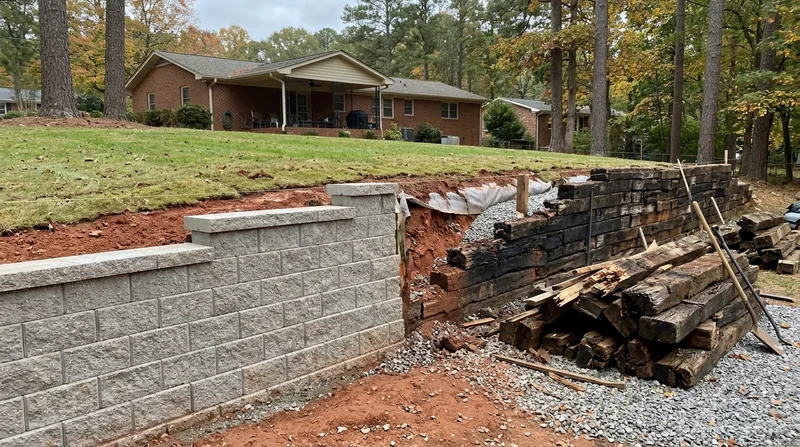




Railroad Tie Wall Replacement in Durham
Durham's red clay hills and the aging timber walls holding them up are a familiar sight across Trinity Park, Watts-Hillandale, and the wooded ravine lots of Forest Hills. If you own a home with a railroad tie wall from the 1980s or 90s, you likely see the warning signs: sagging courses, creosote leaching into the soil, termite damage, and bulging faces after every heavy summer downpour. Railroad Tie Wall Replacement in Durham means removing that failing creosote timber, hauling it away, and rebuilding the wall with a modern drainage system and materials that will not rot, warp, or feed subterranean termites. We handle the demolition, the gravel backfill, and the rebuild in block, concrete, or natural stone, and we do it with the Piedmont's expansive Triassic clays and heavy storm runoff in mind. For homeowners dealing with a wall that is already leaning or has partially collapsed, our leaning and collapsed wall repair service can stabilize the situation before replacement begins. Call (984) 538-7560 to schedule a free estimate.
Why Railroad Tie Walls Are Failing Across Durham's Red Clay Hills
Durham sits in the rolling Piedmont where heavy red clay holds water and the expansive clays of the Triassic Basin swell and shrink with every wet and dry cycle. Railroad tie walls installed 30 to 40 years ago were never designed for that pressure, and the creosote-treated timber itself has a finite lifespan. Add humid summers with hurricane remnants like Fran in 1996, ice storms, and the subterranean termites that thrive under tall loblolly pines and oaks, and most tie walls in this city are well past their service life.
- Timber rots from the inside out, so a wall can look solid while the core is already failing.
- Creosote leaches into garden soil and nearby drainage paths, creating a chemical and environmental concern.
- Subterranean termites tunnel through tie walls and can move from the wall into nearby structures.
- Expansive clay soils push against tie walls that lack proper gravel backfill and drainage, causing bulging and lean.
- Wooden ties settle and shift over decades, opening gaps that let water erode the soil behind the wall.
When you see two or more of these signs, replacement is almost always cheaper than repeated patching. The City of Durham's building department can confirm current permit thresholds for walls on your property.
Key info: A homeowner in Hope Valley had a 1970s railroad tie wall holding a sloped backyard above a walk-out basement. After a summer storm, the middle four courses shifted six inches overnight. We removed the creosote ties, hauled them away, and rebuilt the wall in segmental block with a full gravel drainage column.
You can learn more about local permit rules and wall requirements through the City of Durham government website before scheduling your estimate.
How We Replace a Railroad Tie Wall in Durham, Step by Step
Every railroad tie replacement starts with a site walk to measure the wall height, check the soil and drainage patterns, and confirm access for equipment. We then plan the demolition sequence so the slope stays stable during the rebuild. Because many Durham tie walls sit on tight ravine lots in Forest Hills or against driveways in Parkwood, we bring the right equipment for the access you actually have.
- We document the existing wall and confirm the permit threshold with the City of Durham building department.
- We disconnect any attached fencing, irrigation, or lighting before demolition begins.
- We remove the creosote-treated ties and haul them to an approved disposal facility.
- We excavate and regrade the slope behind the wall to correct the soil pressure that caused the failure.
- We install a compacted gravel drainage column and perforated pipe to move water away from the wall face.
- We rebuild the wall in block, poured concrete, or natural stone, set on a proper footing below frost depth.
- We backfill in compacted lifts and finish the grading so surface water drains away from the wall.
Each step is sequenced so the slope is never left open overnight without temporary support. For walls that need a full rebuild rather than a patch, our retaining wall replacement page walks through the material options in more detail.
Key info: In Northgate Park, a homeowner had a 1980s tie wall along a driveway cut. The ties were termite-damaged and the wall leaned toward the driveway. We removed the ties, rebuilt in poured concrete with a gravel drainage column, and finished the job in four days without blocking driveway access overnight.
Replacement Approaches We Use for Durham Railroad Tie Walls
The right replacement material depends on wall height, soil conditions, access, and how you want the finished wall to look. We match the approach to the site, not the other way around.
| Approach | Description | Best for |
|---|---|---|
| Segmental block | Interlocking concrete block with gravel backfill and drainage pipe | Walls up to 4 feet and terraced walls on sloped lots |
| Poured concrete | Reinforced concrete wall with formed face and drainage column | Tall walls and driveway cuts with heavy surcharge loads |
| Boulder and natural stone | Fieldstone or granite boulders set with gravel backfill | Ravine lots and creek-side slopes where a natural look fits |
| Treated timber (limited use) | Modern pressure-treated lumber for low garden walls | Low walls under 2 feet where budget is the priority |
We confirm the material choice with you before demolition begins so there are no surprises mid-project.
Railroad Tie Wall Replacement Cost in Durham: What to Expect
Pricing for railroad tie wall replacement in Durham starts around $35 per square foot for a basic block rebuild with standard drainage. That figure covers demolition, creosote tie haul-away, gravel backfill, and a new block wall on a proper footing. The final number depends on wall height, length, access for equipment, soil conditions, and the material you choose for the rebuild.
- Wall height and length drive the square footage and the number of courses required.
- Tight access on ravine lots or behind homes in Forest Hills adds labor time for hand-carrying materials.
- Expansive clay soils may require deeper excavation and a larger gravel drainage column.
- Poured concrete and natural stone cost more than block but last longer and suit certain sites better.
- Permit fees and any required engineering add a fixed cost that varies by wall height and location.
Getting two or three estimates is smart because scope and drainage details vary widely between contractors. Our pricing page breaks down the full range so you can compare bids on equal terms.
What to Look for When Hiring a Retaining Wall Contractor Near Me in Durham
Hiring the right contractor matters more than saving a few hundred dollars on the bid. A wall that is rebuilt without proper drainage will fail again within a few years, and creosote tie removal requires careful handling and disposal. Ask direct questions and check the answers before you sign anything.
- Confirm the contractor carries general liability and workers compensation coverage, and ask for a certificate.
- Get at least three written estimates that itemize demolition, drainage, materials, and disposal.
- Ask for references from recent jobs in Durham and call them to ask how the wall has held up.
- Confirm who pulls the permit and whether the wall height triggers an engineered design requirement.
- Check HOA rules for wall height, material, and color before work begins.
We are fully insured and carry NCMA Segmental Retaining Wall Installer Certification, and we are happy to provide proof of coverage on request. Reach out through our contact page to schedule your free estimate.
Railroad Tie Wall Replacement in Durham: Pricing Guide
| Service | Price | Details |
|---|---|---|
| Block wall replacement (standard) | Starting at $35/sq ft | Includes tie demolition, haul-away, gravel backfill, drainage pipe, and new block wall on footing |
| Poured concrete replacement | Starting at $48/sq ft | Includes formed and reinforced concrete wall, drainage column, and creosote tie disposal |
| Boulder and natural stone replacement | Starting at $55/sq ft | Includes stone setting, gravel backfill, and drainage, with cost driven by stone availability and access |
| Complex or large-scale job | On estimate | Tall walls, tiered designs, and tight ravine access need an on-site look before pricing |
| Travel | Included | In Durham and surrounding areas, no separate call-out or mileage fee |
| Estimate | Free | Response within 24h at (984) 538-7560, no obligation to book |
Indicative pricing, the exact cost depends on square footage, finish, and site access. Free personalized estimate within 24h at (984) 538-7560.


